Super Bowl XII: The Rise of the Doomsday Defense and a Historic Night in New Orleans
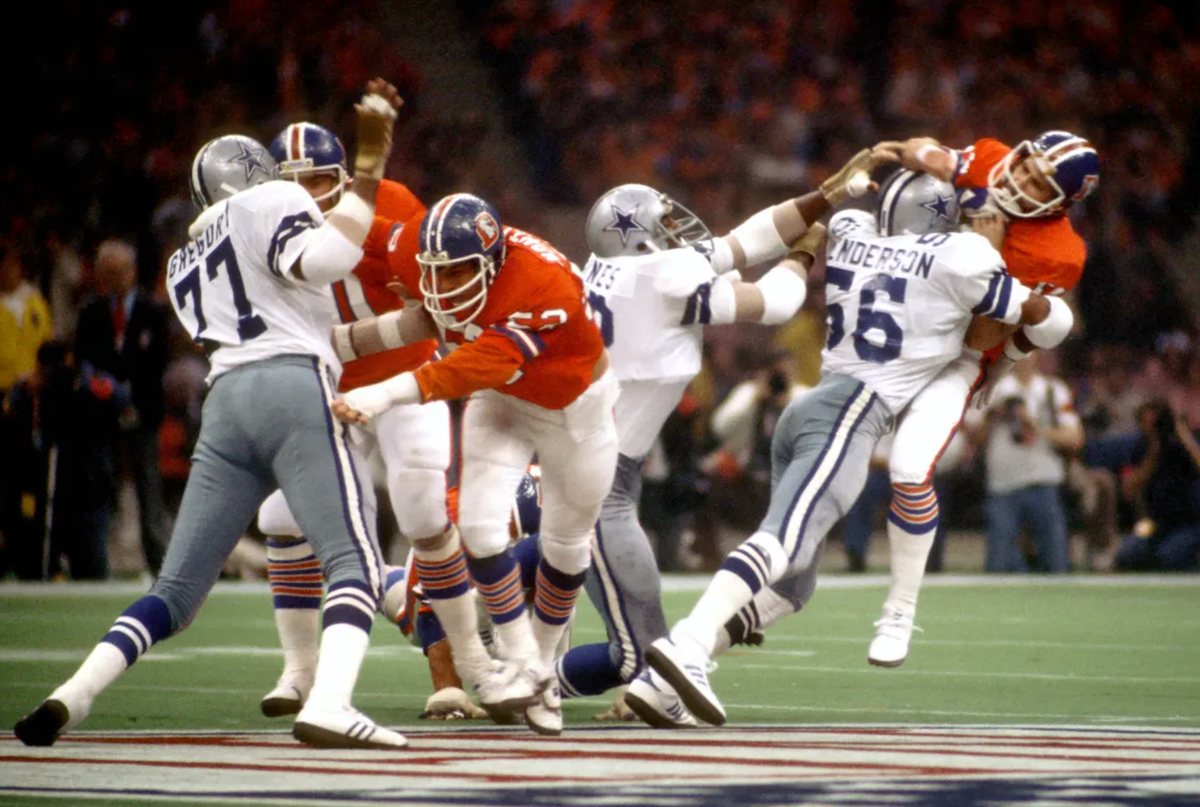
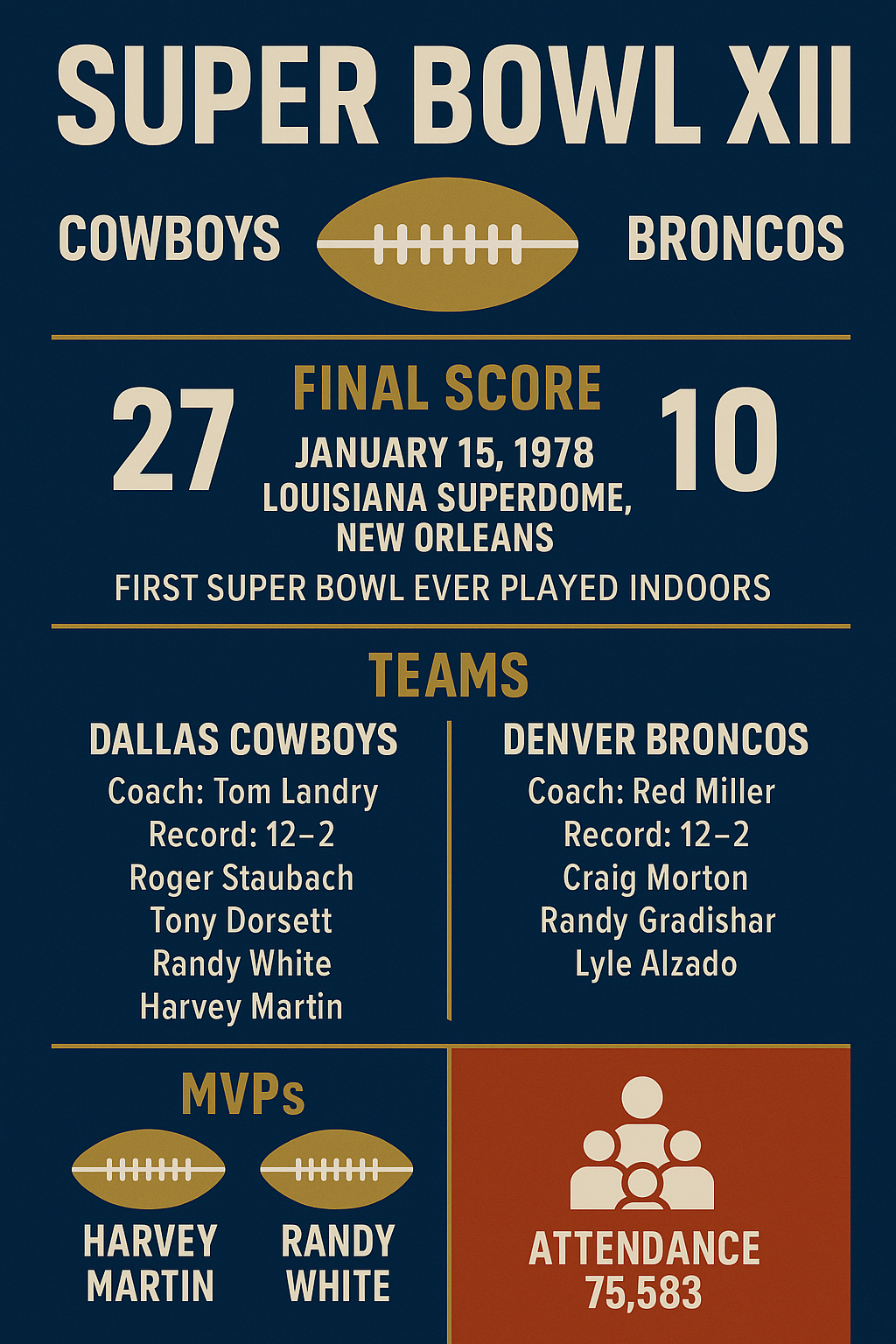
Super Bowl XII, played on January 15, 1978, at the Louisiana Superdome in New Orleans, marked a pivotal moment in NFL history. It was a clash not only between two powerhouse franchises—the Dallas Cowboys and the Denver Broncos—but also between two contrasting styles of football: the defensive juggernaut of Dallas’s “Doomsday Defense” and the improbable rise of a Denver team built around grit, defense, and a fanbase experiencing its first taste of glory. The game also made history as the first Super Bowl played indoors and the first to award co-MVP honors. For fans of football and sports history, Super Bowl XII remains a defining contest that showcased the strategic depth and evolving spectacle of America’s most-watched game.
"Super Bowl XII wasn’t just a win—it was a masterclass in defensive football. The Cowboys didn’t just beat Denver; they dismantled them at every level, proving that pressure and precision up front can dictate the entire tempo of a championship game."
— Raymond Nash, NFL Defensive Strategy Analyst
The Road to Super Bowl XII
The 1977 NFL season was shaped by dominant defenses and emerging quarterbacks, a pattern reflected in the two teams that met in Super Bowl XII.
Dallas Cowboys: America’s Team Assembles
Led by head coach Tom Landry, the Dallas Cowboys entered the 1977 season with renewed focus. After a bitter NFC Championship loss the previous year, the Cowboys added key talent—most notably, rookie running back Tony Dorsett, the Heisman Trophy winner from the University of Pittsburgh. Dallas finished the regular season 12–2, powered by a dynamic offense led by quarterback Roger Staubach and a smothering defense known as the “Doomsday Defense,” featuring linemen Harvey Martin and Randy White, linebacker Thomas “Hollywood” Henderson, and defensive back Cliff Harris.
In the playoffs, Dallas cruised past the Chicago Bears 37–7 in the Divisional Round and overwhelmed the Minnesota Vikings 23–6 in the NFC Championship, setting the stage for their third Super Bowl appearance.
Denver Broncos: The Orange Crush Rises
For the Denver Broncos, the 1977 season was historic. After over a decade of mediocrity since the AFL-NFL merger, Denver, under first-year head coach Red Miller and general manager Fred Gehrke, finished the season 12–2. The team’s identity was built around the “Orange Crush” defense, led by linebacker Randy Gradishar, defensive linemen Rubin Carter and Lyle Alzado, and a cohesive, swarming unit that suffocated opponents.
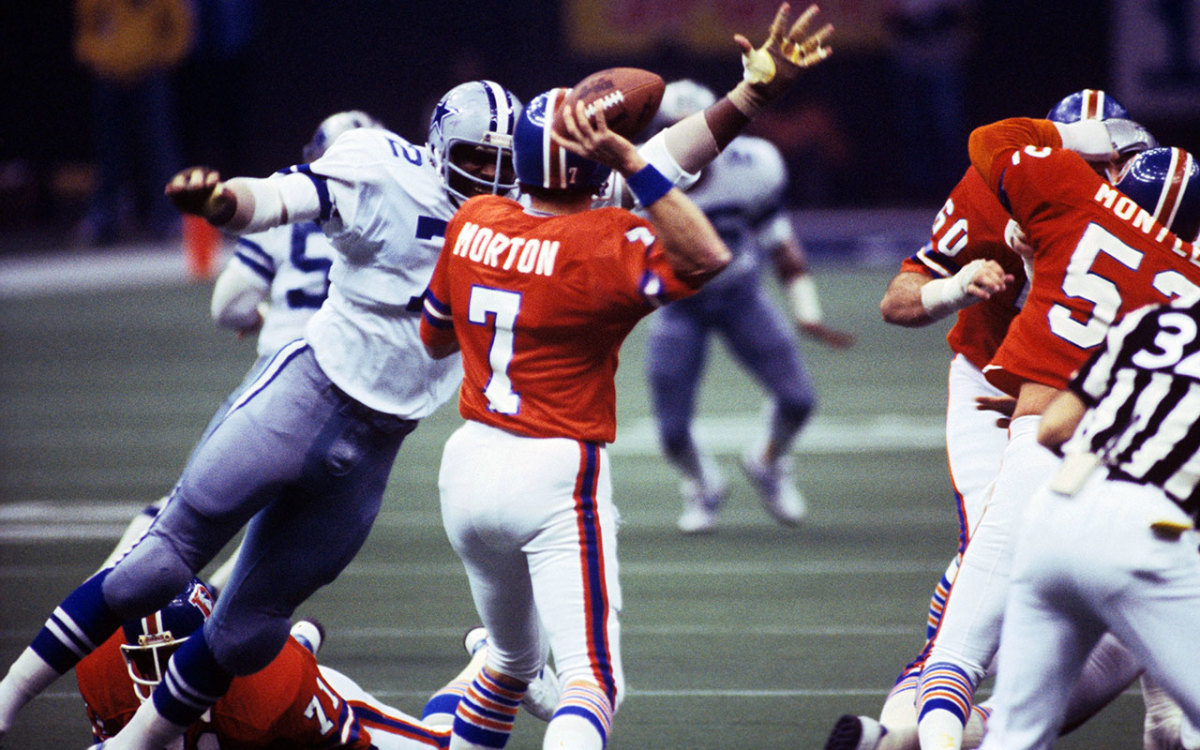
Offensively, quarterback Craig Morton—once the starter for the Cowboys in Super Bowl V—provided veteran leadership. Denver's postseason journey included a 34–21 win over the Pittsburgh Steelers and a hard-fought 20–17 victory over the defending champion Oakland Raiders in the AFC Championship, propelling the franchise to its first Super Bowl.
The Matchup: Cowboys vs. Broncos
Super Bowl XII was billed as a battle of defenses, but it quickly turned into a showcase for one side's dominance. Though the game featured familiar faces—most notably Craig Morton, who once battled Staubach for the starting job in Dallas—it became evident early on that Morton's homecoming would be far from triumphant.
With the Superdome crowd of 75,583 fans and millions watching on CBS, the Cowboys set out to prove they were not just “America’s Team” in marketing, but on the field as well.
The Game: Dallas Dominates
From the opening kickoff, the Cowboys imposed their will. The game plan was clear: pressure Craig Morton, force mistakes, and let Staubach manage a conservative, efficient offensive attack. Dallas executed to near perfection.
By the end of the first quarter, the Cowboys led 10–0 after a Rafael Septién field goal and a 1-yard touchdown plunge from fullback Jim Newhouse. Denver’s offense, meanwhile, struggled mightily. Morton was hounded relentlessly by the Dallas defensive line, especially Harvey Martin and Randy White, who combined for multiple sacks and pressures.
Dallas's “flex defense” disguised coverages and confused Morton, who threw four interceptions and completed just 4 of 15 passes for 39 yards before being benched for backup Norris Weese in the second half. Denver committed eight turnovers in total—four interceptions and four fumbles—tying a Super Bowl record.
Dallas added another touchdown in the second quarter on a 7-yard pass from Staubach to tight end Billy Joe Dupree. At halftime, the Cowboys led 13–0, a reflection of their defensive dominance.
Though Denver mustered a late push in the third quarter, including a touchdown drive led by Weese and a 47-yard field goal by Jim Turner, Dallas answered with a decisive fourth-quarter score: a 29-yard touchdown run by Dorsett and a Staubach pass to Butch Johnson, extending the lead to 27–10.
Final score: Dallas Cowboys 27, Denver Broncos 10.
"You could see it in the first quarter—Craig Morton never had a chance. Martin and White turned the Superdome into a nightmare factory. This was the game that redefined how much of an impact a defensive line can have on the biggest stage."
— Lorraine Fields, Sports Historian & Super Bowl Commentator
MVPs: A Defensive First
For the first time in Super Bowl history, co-MVP honors were awarded—to Harvey Martin and Randy White, both of the Cowboys defensive line. Their combined efforts dismantled the Broncos' offensive line, disrupted every facet of Denver’s passing attack, and established a new benchmark for defensive play in championship games.
Martin, the 1977 NFL Defensive Player of the Year, and White, an emerging star in his third year, perfectly embodied the power and tenacity of the “Doomsday Defense II.” Their selection marked the first time defensive linemen won Super Bowl MVP—and remains one of the rare instances that defenders have received the game’s top honor.
Legacy and Impact
Super Bowl XII marked the second Super Bowl title for the Dallas Cowboys and head coach Tom Landry. It was validation of Landry’s complex schemes, from his offensive motion systems to the innovative flex defense. It also solidified Roger Staubach’s place among the elite quarterbacks of his era and proved that Dallas could win with both flash and force.
For Denver, the loss was humbling but also foundational. The Broncos had proven they belonged among the NFL elite and sparked a fan base that would become one of the most passionate in football. Though it would take nearly two decades for Denver to finally win a Super Bowl (XXXII in 1998), their journey began with this breakthrough season.
Beyond the field, Super Bowl XII was also notable for the venue and presentation. Played in the Superdome—the first indoor Super Bowl—it showed how modern stadiums could elevate the spectacle of the game. CBS introduced improved graphics and slow-motion replays, reflecting the increasing importance of television in shaping the Super Bowl experience.
Cultural Context: A Nation Watches
By the late 1970s, the Super Bowl had become not just a sports event but a cultural phenomenon. Super Bowl XII drew an estimated 78 million viewers, a record at the time. The halftime show, produced by Disney and featuring a “From Paris to Paris of America” theme, reflected the NFL’s growing appeal to broader audiences beyond football diehards.
The game’s broadcast team—Pat Summerall and Tom Brookshier—brought gravitas and clarity to the play-by-play, making it accessible to both newcomers and diehard fans. Meanwhile, advertisers began to recognize the marketing power of the Super Bowl, setting the stage for the multi-million-dollar commercial extravaganzas of later decades.
The Aftermath
Dallas used the momentum of Super Bowl XII to remain a contender for years, returning to the Super Bowl in 1979 (Super Bowl XIII) only to fall to the Pittsburgh Steelers in a shootout. The Broncos, despite their struggles in Super Bowl XII, laid the foundation for future success under the leadership of John Elway in the late 1980s and eventually won back-to-back titles in the late 1990s.
Craig Morton retired after the 1982 season, and despite his poor performance in Super Bowl XII, he remains notable for being the only quarterback to start the Super Bowl for two different teams (Dallas in V and Denver in XII) until Kurt Warner and Peyton Manning later matched the feat.
Super Bowl XII remains a landmark in NFL history—not just because of the outcome, but because of what it revealed about the evolving nature of football. It was a game dominated by defense, where schemes, preparation, and execution mattered more than flashy offensive numbers. It showed the power of a unified team philosophy and the importance of coaching innovation.
The image of Harvey Martin and Randy White hoisting the co-MVP trophy together, surrounded by teammates and confetti in the Superdome, still resonates as one of the most iconic in Super Bowl lore. For the Dallas Cowboys, it was a night of vindication. For the Denver Broncos, it was the start of a long journey. And for fans of the game, Super Bowl XII stands as a testament to the timeless adage: defense wins championships.
Key Stats from Super Bowl XII:
- Final Score: Cowboys 27, Broncos 10
- MVPs: Harvey Martin & Randy White (Co-MVPs)
- Turnovers Forced by Dallas: 8
- Passing Yards (Broncos): 61
- Staubach's Stats: 17/25, 183 yards, 1 TD
- Dorsett's Stats: 15 carries, 66 yards, 1 TD
- Attendance: 75,583
- Television Viewership: ~78 million
