Super Bowl XIII: The Battle of the Titans – Steelers vs. Cowboys
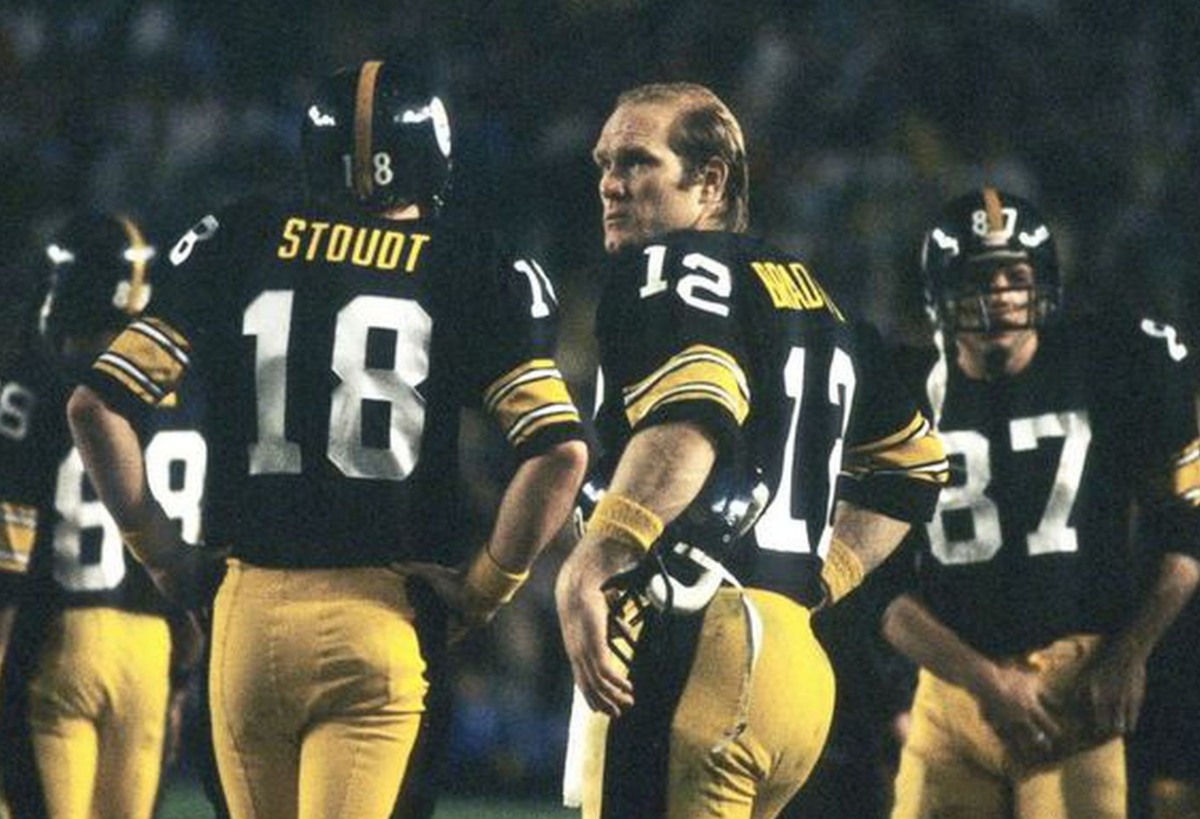
Super Bowl XIII, held on January 21, 1979, at the Orange Bowl in Miami, Florida, was a clash of NFL titans that lived up to every bit of its pre-game hype. Pitting the Pittsburgh Steelers against the Dallas Cowboys, it marked the first Super Bowl rematch and is often hailed as one of the most competitive and star-studded games in NFL history. With legendary players, high-stakes drama, and iconic moments, Super Bowl XIII stands as a benchmark for all championship games that followed.
Pre-Game Build-Up: A Clash of Dynasties
By the late 1970s, the NFL had transformed into a cultural force in American life, and no two teams embodied the decade’s gridiron excellence more than the Pittsburgh Steelers and Dallas Cowboys. The Steelers had already won two Super Bowls (IX and X) under head coach Chuck Noll, riding the talents of quarterback Terry Bradshaw, running back Franco Harris, and a suffocating defense known as the “Steel Curtain.”
On the other side, the Cowboys, coached by the cerebral Tom Landry, had claimed Super Bowl VI and XII and were the defending champions heading into Super Bowl XIII. Quarterback Roger Staubach, wide receiver Drew Pearson, and running back Tony Dorsett led a high-octane offense supported by the “Doomsday Defense.”
This was more than just a football game—it was a showdown for NFL supremacy. Both teams were seeking a third Super Bowl title, a feat never before accomplished. The media dubbed it “The Dream Game,” and with a combined 15 future Hall of Famers on the field, it truly lived up to that billing.
The Setting
The Orange Bowl, packed with over 80,000 fans, basked in the sunny Miami warmth. Super Bowl XIII was broadcast on NBC, with announcers Curt Gowdy and John Brodie providing commentary. The pre-game and halftime festivities featured the theme "Carnival," with performances by Ken Hamilton and various dance troupes.
Betting odds listed the Steelers as 3.5-point favorites, but public sentiment was largely split, reflecting just how evenly matched the teams were on paper.
First Half: A Heavyweight Exchange
Pittsburgh got off to a quick start. On their opening possession, Bradshaw led a methodical drive that culminated in a 28-yard touchdown pass to wide receiver John Stallworth, giving the Steelers a 7-0 lead. Dallas responded swiftly. Roger Staubach orchestrated a drive capped off by a 39-yard touchdown strike to Tony Hill, tying the score.
The momentum see-sawed again. Bradshaw found Stallworth on a deep post for a 75-yard touchdown, electrifying the crowd and pushing the Steelers ahead 14-7. However, Bradshaw would fumble later, and Dallas capitalized, recovering the ball deep in Pittsburgh territory. But the Steelers’ defense stiffened, and the Cowboys had to settle for a 27-yard field goal from Rafael Septién, making it 14-10.
Then came a pivotal moment late in the second quarter: a fumble by Staubach gave the Steelers the ball with great field position. Bradshaw struck again, hitting Rocky Bleier on a play-action pass for a 7-yard touchdown. The Steelers led 21-10 at halftime, and Bradshaw had already thrown for three touchdowns.
"This was more than just a rematch—it was a full-blown heavyweight brawl between two dynasties. Pittsburgh and Dallas didn’t just want to win; they wanted to prove who ruled the decade. And on that Miami turf, it was Terry Bradshaw who fired the first—and last—shots." - Elvis from Superbowl History
Second Half: Drama and Controversy
The third quarter saw limited scoring but pivotal moments, including one of the most infamous drops in Super Bowl history. With Dallas deep in Pittsburgh territory, Staubach threw a perfect pass to tight end Jackie Smith, who was wide open in the end zone. Smith inexplicably dropped the pass, and the Cowboys had to settle for a field goal instead of a game-tying touchdown. The moment has been replayed endlessly in Super Bowl lore and is remembered as a cruel twist for a future Hall of Famer.
Pittsburgh then asserted its dominance in the fourth quarter. A controversial pass interference call on Cowboys defensive back Benny Barnes set up a touchdown run by Franco Harris. Then, on the ensuing kickoff, Cowboys fullback Randy White, who was playing with a broken thumb, fumbled the return. The Steelers recovered, and Bradshaw immediately connected with Lynn Swann for an 18-yard touchdown, extending the lead to 35-17.
Despite the deficit, Staubach did not give up. He engineered two quick touchdown drives, including a 7-yard pass to Butch Johnson and a 4-yard strike to Billy Joe Dupree, bringing the Cowboys within 35-31 with just 22 seconds left. But it was too little, too late. The Steelers recovered the onside kick and ran out the clock.
Final Score
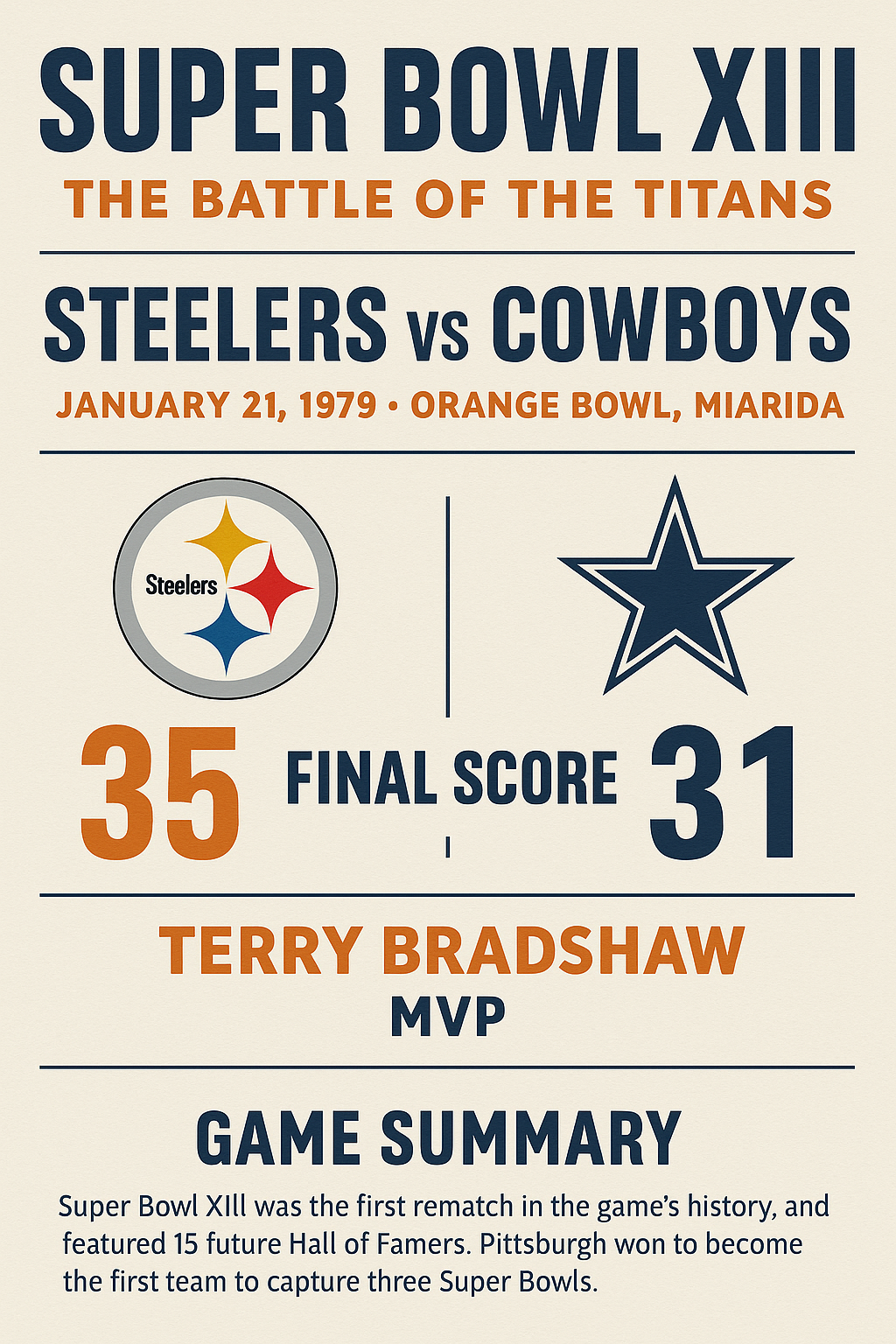
- Pittsburgh Steelers: 35
- Dallas Cowboys: 31
It was the highest-scoring Super Bowl at the time, with a combined 66 points, and still remains one of the most thrilling finishes in NFL history.
MVP and Stats
Terry Bradshaw was named Super Bowl XIII MVP after throwing for 318 yards and four touchdowns. It was a vindication for Bradshaw, who had often been criticized earlier in his career as being more brawn than brains. This performance firmly cemented his legacy.
Other key stats:
- Franco Harris: 68 rushing yards, 1 TD
- John Stallworth: 3 catches, 115 yards, 2 TDs
- Lynn Swann: 7 catches, 124 yards, 1 TD
- Roger Staubach: 228 passing yards, 3 TDs
- Tony Dorsett: 96 total yards
Historical Impact
Super Bowl XIII was not just another title win—it marked the first time a team had won three Super Bowls. The Steelers would go on to win another the following year, making them the team of the decade and the first to win four Super Bowls.
For Dallas, the loss was crushing. Though Staubach played valiantly, the game would be his final Super Bowl appearance. The Cowboys’ dynasty continued into the early 1980s, but Super Bowl XIII is often cited as the one that got away.
Jackie Smith’s dropped pass became a symbol of how a single moment can alter history. Meanwhile, the officiating controversy over pass interference lingered in debates, especially among Cowboys fans.
Legacy
Super Bowl XIII remains one of the most revered NFL games ever played. The level of talent on both sidelines—Bradshaw, Swann, Harris, Greene, Lambert, Ham for Pittsburgh; Staubach, Dorsett, Pearson, White, Harris for Dallas—is unmatched in Super Bowl history.
NFL Films has celebrated the game in numerous documentaries, calling it one of the “Top 10 Super Bowls of All Time.” Its narrative, intensity, and drama have made it a gold standard for NFL championship games.
Additionally, the rematch aspect—Pittsburgh had previously beaten Dallas in Super Bowl X—added a storyline that emphasized the cyclical nature of greatness and rivalry. These two franchises were mirror images in many ways, with gritty coaching, iconic quarterbacks, and passionate fan bases.
The Steelers' victory in Super Bowl XIII helped elevate Pittsburgh from a blue-collar city into a nationally celebrated sports town. It also elevated Chuck Noll's coaching status and underscored the Steelers' draft genius—assembling a team with so many Hall of Famers largely through shrewd drafting.
Super Bowl XIII was more than just a football game. It was a confluence of history, excellence, heartbreak, and redemption. The Steelers' 35-31 victory over the Cowboys capped a decade of dominance and left an indelible mark on the sport. For fans, historians, and the NFL itself, this game remains one of the purest examples of what makes football America’s game—strategy, toughness, emotion, and drama.
More than four decades later, Super Bowl XIII is still remembered not just for who won, but how it was played—with grit, flair, and a cast of legends that shaped the modern NFL.
"Super Bowl XIII wasn’t for the faint of heart. It was dropped passes, bone-crunching hits, and quarterbacks who refused to flinch. In the end, Bradshaw walked away with MVP honors, four touchdown passes deep in his holster, and the Steelers’ third ring in hand." - Dave from Superbowl History
