Super Bowl XVII: The Diesel Runs Wild — Washington Powers Past Miami
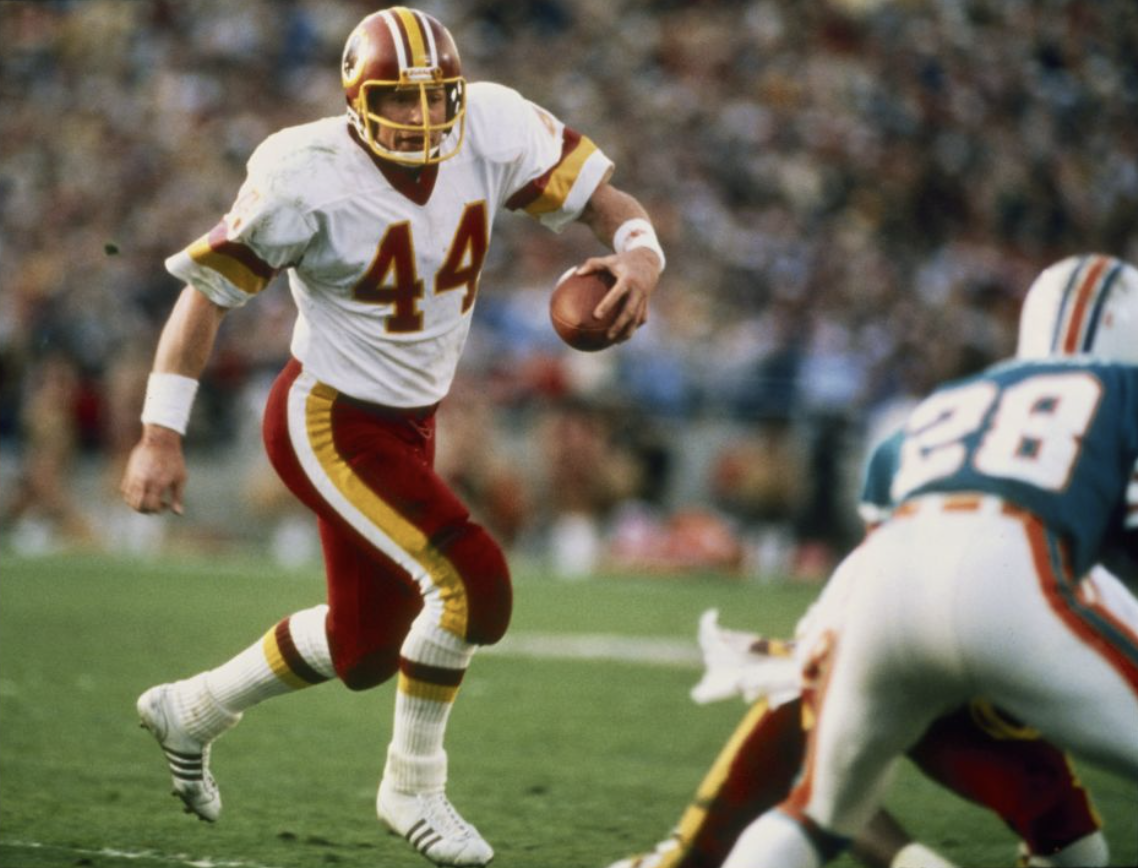
On January 30, 1983, in front of over 100,000 fans at the Rose Bowl in Pasadena, California, the Washington Redskins and Miami Dolphins squared off in Super Bowl XVII, a game defined by power football, redemption, and grit. Washington’s 27–17 victory, driven by the unstoppable force of John Riggins and anchored by a suffocating defense, marked the franchise’s first Super Bowl title and a shift in the NFL landscape.
This wasn’t just a championship—it was a battle of philosophies: Miami’s precision passing and exotic defense versus Washington’s smashmouth running and physicality. And by the time the clock hit zero, one thing was clear: in football, sometimes brute force wins.
The Context: Strike-Shortened Season, Familiar Opponents
The 1982 NFL season was unlike any other. A 57-day players' strike reduced the regular season to just nine games, and the league implemented a 16-team “Super Bowl Tournament” playoff structure. It was chaotic, controversial, and perfect for a surprise champion.
The Washington Redskins, under second-year head coach Joe Gibbs, entered the postseason as the NFC's No. 1 seed. Gibbs, who had once been an offensive coordinator for Don Coryell’s high-flying Chargers, had transformed his team into a ground-and-pound juggernaut. Their secret weapon? Running back John Riggins, a bruising 230-pound workhorse.
The Miami Dolphins, coached by Don Shula, boasted the NFL’s top-ranked defense, the “Killer B’s”, and second-year quarterback David Woodley, a mobile passer with an unpredictable arm. They also had history on their side: Miami had beaten Washington 14–7 in Super Bowl VII, a fact not lost on the fans or media.
“Super Bowl XVII was football’s answer to a heavyweight title fight. One team came to dance, the other came to brawl,” said Leon Sanders, senior archivist at the Super Bowl Historical Society. “It was a test of will, and Washington simply refused to lose.”
The Setting: A Record Crowd and National Spotlight
The Rose Bowl provided a stunning backdrop, hosting its second Super Bowl (after Super Bowl XI). The game drew a record attendance of 103,667 and was broadcast on CBS, with Pat Summerall and John Madden on the call.
The pregame show featured the Los Angeles Unified School District All-City Band, and the national anthem was performed by Leslie Easterbrook. At halftime, the crowd was treated to a “KaleidoSUPERscope” spectacle with the L.A. Super Drill Team and a salute to California's diversity.
Super Bowl XVII arrived at a moment of renewal—just days after President Ronald Reagan’s inauguration for his second term—and fans were hungry for heroes and hard-nosed football.
First Half: Dolphins Strike, Washington Responds
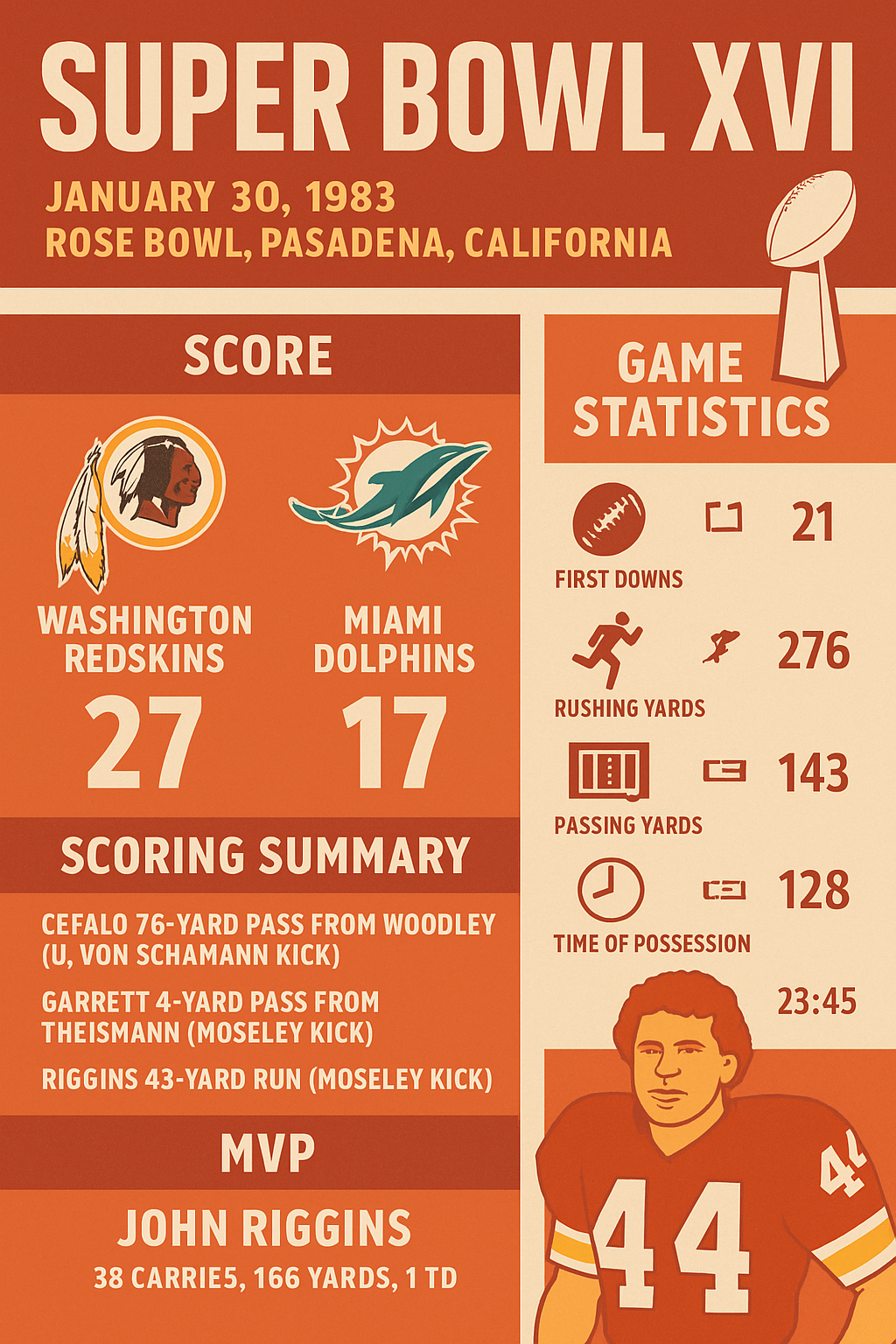
The game began with an explosive play. On Miami’s second possession, David Woodley connected with receiver Jimmy Cefalo for a 76-yard touchdown, the longest play from scrimmage at that point in Super Bowl history. Miami led 7–0 and looked poised to run their speed game.
But Washington answered. Riggins pounded out yards and helped set up a 31-yard field goal by Mark Moseley. Then, a 4-yard touchdown pass from quarterback Joe Theismann to Alvin Garrett gave Washington a 10–7 lead.
Miami responded late in the second quarter. After a fumble recovery, they tacked on a field goal, and shortly after, Woodley ran in a short touchdown to give the Dolphins a 17–10 halftime lead.
Though Miami led, momentum was shaky. Washington’s line was dominating time of possession, and Riggins was just warming up.
Second Half: Riggins Takes Over
The third quarter was all Washington. The defense, led by Dexter Manley, Darrell Green, and Mark Murphy, shut down Woodley and stifled Miami’s running game.
Washington tied the game at 17–17 with another field goal from Moseley. Then came the play that would define the game—and perhaps the era.
Facing 4th-and-1 at the Dolphins’ 43-yard line, Gibbs made the bold call to go for it. He handed the ball to Riggins, who blasted through the left side, broke a tackle from cornerback Don McNeal, and sprinted down the sideline for a 43-yard touchdown.
It was the signature moment of Super Bowl XVII. The Redskins took a 24–17 lead, and the Rose Bowl shook as Riggins raised the ball in celebration.
“That fourth-down run was seismic,” said Margot Alvarez, curator at the Super Bowl Historical Society. “It wasn’t just a great play—it was a declaration. Washington was no longer a team searching for identity. They had found it, and it looked a lot like John Riggins.”
From that point on, Washington controlled the clock, wore down Miami’s defense, and added a late field goal to seal the win.
Final Score
- Washington Redskins: 27
- Miami Dolphins: 17
MVP and Notable Performances
John Riggins was named Super Bowl XVII MVP after an iconic performance:
- 38 carries
- 166 rushing yards (then a Super Bowl record)
- 1 touchdown
- Countless bruises delivered
Riggins was the first player in NFL history to rush for over 100 yards in four straight playoff games, and his postseason run (610 yards) remains one of the most dominant in league history.
- Joe Theismann: 15-of-23 for 143 yards, 2 TDs, 2 INTs
- Dexter Manley: 1 sack, multiple pressures, and constant disruption
- David Woodley (MIA): 4-of-14 for 97 yards, 1 TD, 1 INT—benched in the 4th quarter
- Jimmy Cefalo: 76-yard TD reception
Coaching Brilliance and the Hogs
Joe Gibbs' offensive strategy emphasized a dominant line, nicknamed “The Hogs”—Russ Grimm, Joe Jacoby, Mark May, Jeff Bostic, and George Starke—who paved the way for Riggins all game. Their ability to control the line of scrimmage for four quarters effectively neutralized Miami’s athletic front.
Gibbs’ fearless 4th-and-1 call proved decisive, and his combination of clock management and trench warfare became the template for playoff football in the 1980s.
Strategic Takeaways
- Time of Possession: Washington held the ball for over 36 minutes, keeping Miami’s defense on the field and their offense cold.
- Playoff Football Is Physical: Riggins wore down defenders, especially in the second half.
- QB Play Matters: Woodley’s inaccuracy (4 completions all game) crippled Miami, while Theismann did just enough.
Cultural and Historical Significance
Super Bowl XVII wasn’t just a win—it was a rebirth. Washington had endured years of mediocrity but now stood atop the NFL thanks to a coach who believed in adapting, a quarterback who once broke his leg in the CFL, and a running back who’d briefly retired over a contract dispute.
Riggins’ rugged performance became legendary in the nation's capital, and his image—mowing down defenders with mud on his jersey—became symbolic of the early ‘80s NFL: tough, no-frills, team-first football.
The win also cemented Joe Gibbs’ legacy, who would go on to win two more Super Bowls (1987 and 1991), all with different quarterbacks—a feat unmatched in NFL history.
For Miami, the loss stung. Don Shula had coached brilliantly all season, but his team lacked offensive punch. Within a year, he’d make the bold decision to draft a cannon-armed quarterback out of Pittsburgh named Dan Marino, reshaping the franchise's future.
Media and Broadcast Legacy
CBS’s broadcast reached over 88 million viewers, breaking the previous year’s viewership record. The game was watched by an estimated 40% of American households, making it one of the most popular TV events of the year.
It was also the first Super Bowl with a live national closed captioning feed—making the game more accessible to the hearing impaired and setting a new broadcast standard.
Legacy
Super Bowl XVII launched Washington into a decade of excellence. The team would return to two more Super Bowls under Gibbs and would dominate the NFC East alongside rivals like the Giants and Cowboys.
John Riggins’ 1983 postseason remains a case study in how a dominant running back can carry a team to glory. His 43-yard run became part of NFL mythology, and he was eventually enshrined in the Pro Football Hall of Fame.
The Dolphins, while stymied in this game, used the defeat as fuel. With Dan Marino, they’d return to the Super Bowl in 1984—but Shula’s wait for another Lombardi would continue.
Final Thoughts
Super Bowl XVII may not have featured the flash of a passing duel or a last-minute comeback, but it delivered something purer: power, heart, and unrelenting will. It was a game where strategy met toughness, and where heroes weren’t born—they were forged on 4th-and-1 with 100,000 people watching.
“This wasn’t just Riggins’ game—it was his legacy,” said Leon Sanders of the Super Bowl Historical Society. “He dragged defenders, fans, and the entire franchise into the end zone with him.”
Washington had arrived. The Diesel was running, and the NFL would never be the same.