Super Bowl XXXV: Baltimore’s Brutal Defense Defines a Dynasty
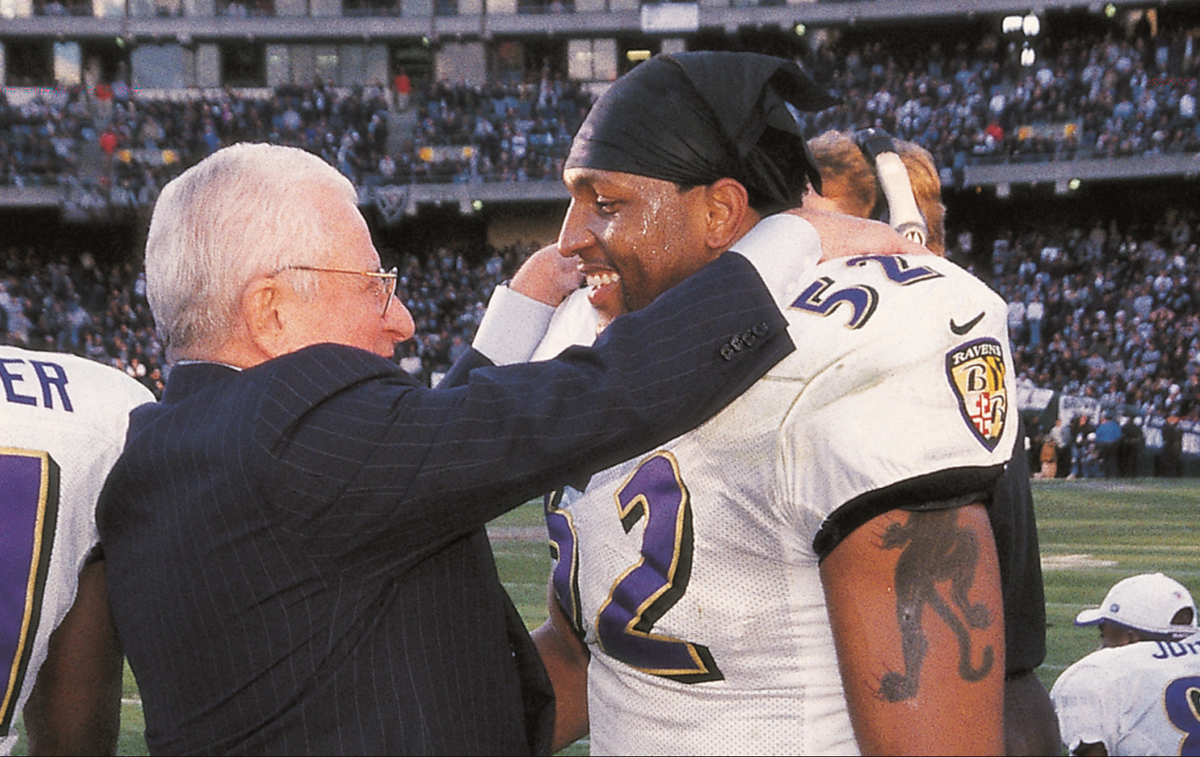
On January 28, 2001, at Raymond James Stadium in Tampa, Florida, the Baltimore Ravens delivered a defensive performance for the ages, crushing the New York Giants by a score of 34–7 in Super Bowl XXXV. While offensive fireworks often dominate the Super Bowl spotlight, this game proved that defense—smashmouth, unrelenting, suffocating defense—can still steal the show.
The Ravens’ triumph was not just about winning a championship. It was about how they won: by overwhelming their opponent with physicality, discipline, and a historically elite unit led by Ray Lewis, who earned Super Bowl MVP honors for a performance that was more psychological than statistical.
“Super Bowl XXXV wasn’t just a game—it was a defensive masterclass,” said Jonathan Prell, senior historian with the Super Bowl Historical Society. “Baltimore made the Giants look like they didn’t belong on the same field. It was clinical. It was primal. It was beautiful, if you appreciate football violence executed with precision.”
The Matchup: Two Teams Built on Grit
The Baltimore Ravens, in just their fifth season since relocating from Cleveland, entered the game with a ferocious reputation. They finished the regular season 12–4, anchored by a defense that allowed a record-low 165 points—just over 10 points per game. Baltimore’s offense, led by journeyman quarterback Trent Dilfer, was unspectacular but efficient enough to complement their defensive might.
The New York Giants, also 12–4, were riding high after a 41–0 demolition of the Minnesota Vikings in the NFC Championship. Their quarterback, Kerry Collins, had experienced a late-career resurgence, and their defense, anchored by Michael Strahan and Jason Sehorn, had begun to gel at the right time. But against Baltimore, that cohesion would fracture.
First Half: Baltimore Sets the Tone
From the opening kickoff, the Ravens asserted their dominance. After forcing a three-and-out on the Giants’ first possession, the Ravens struck early with a 38-yard touchdown pass from Dilfer to Brandon Stokley, giving them a 7–0 lead.
For the rest of the half, Baltimore’s defense throttled the Giants. Ray Lewis roamed sideline to sideline, disrupting plays and coordinating the defense like a battlefield general. Sam Adams, Tony Siragusa, and Peter Boulware constantly collapsed the pocket, making life miserable for Collins.
The Giants didn’t manage a single first down until the second quarter and committed multiple penalties that kept them out of rhythm. Baltimore extended the lead with a 47-yard Matt Stover field goal, making it 10–0 at the half.
“It was a shutdown clinic. Kerry Collins looked like a college freshman who stumbled into an NFL game,” noted Celeste Rinehart, an analyst for the Super Bowl Historical Society. “The Giants couldn’t even get into field goal range. Baltimore dared them to try anything—and then punished them for it.”
Second Half: A Special Teams Frenzy
The third quarter offered one of the most bizarre and electrifying sequences in Super Bowl history.
Baltimore’s Duane Starks intercepted Collins and returned it 49 yards for a touchdown, giving the Ravens a commanding 17–0 lead.
On the ensuing kickoff, the Giants' Ron Dixon stunned the Ravens by returning it 97 yards for a touchdown, cutting the lead to 17–7.
But the excitement was short-lived.
Ravens return man Jermaine Lewis answered right back with his own 84-yard kickoff return, pushing the lead back to 24–7 in a span of just 36 seconds. The three-touchdown burst in under a minute was unprecedented.
The Giants never recovered. Collins continued to struggle under pressure, throwing four interceptions and being sacked four times. Baltimore added another field goal and a 3-yard touchdown run from Jamal Lewis in the fourth quarter to seal the 34–7 blowout.
Final Score and Scoring Summary
| Quarter | Ravens | Giants |
|---|---|---|
| 1st | 7 | 0 |
| 2nd | 3 | 0 |
| 3rd | 14 | 7 |
| 4th | 10 | 0 |
| Total | 34 | 7 |
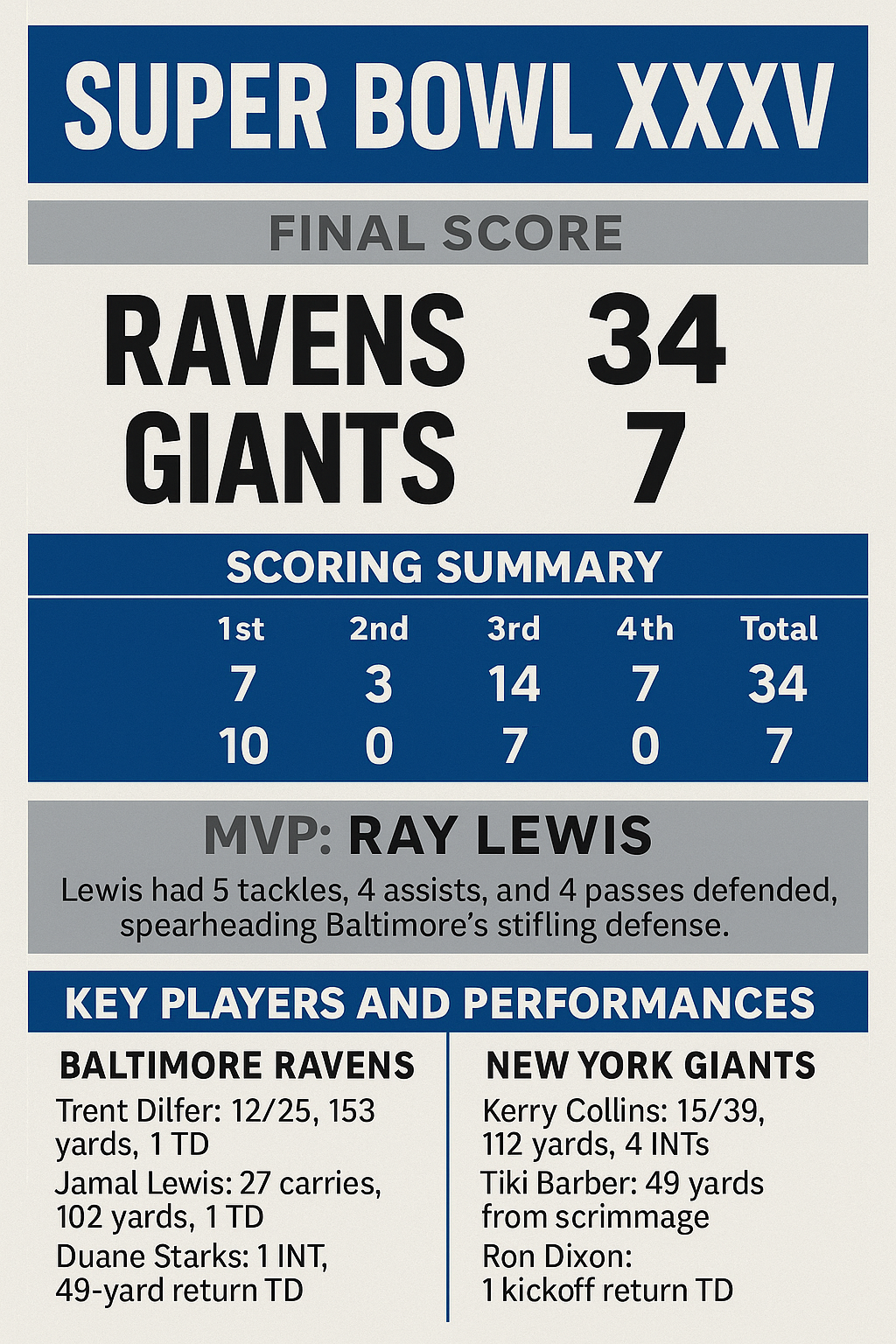
MVP: Ray Lewis
Linebacker Ray Lewis was named Super Bowl MVP, becoming the second linebacker in history to earn the honor. While his stat line was solid—5 tackles, 4 assists, and 4 passes defended—it was his leadership, anticipation, and relentless motor that shaped the game.
Lewis’ fingerprints were on every defensive play, both physically and emotionally. He called the plays, read the Giants’ offense like a book, and delivered punishment at every level of the field.
Key Players and Performances
Baltimore Ravens
- Trent Dilfer: 12/25, 153 yards, 1 TD, 0 INT
- Jamal Lewis: 27 carries, 102 yards, 1 TD
- Brandon Stokley: 3 catches, 52 yards, 1 TD
- Jermaine Lewis: 152 return yards, 1 kickoff return TD
- Ray Lewis: MVP; 9 total tackles, 4 pass deflections
- Duane Starks: 1 INT, 49-yard pick-six
- Chris McAlister and Kim Herring: 2 additional INTs
New York Giants
- Kerry Collins: 15/39, 112 yards, 0 TD, 4 INT
- Ron Dixon: 97-yard kickoff return TD
- Tiki Barber & Joe Montgomery: Combined 40 rushing yards
- Amani Toomer: 3 catches, 30 yards
The Defense: A Historic Benchmark
The 2000 Ravens defense is widely considered one of the greatest in NFL history, and Super Bowl XXXV was its crown jewel. Over the postseason, Baltimore allowed just 23 total points in four games—an average of under 6 per game.
They held the Giants to 152 total yards, forced 5 turnovers, and did not allow an offensive touchdown. Baltimore’s defenders tackled with fury, communicated like chess masters, and flew to the ball with terrifying speed.
The unit featured legends like Ray Lewis, Rod Woodson, Jamie Sharper, Peter Boulware, and Chris McAlister, all playing their absolute best at the most important time.
The Offense: Just Enough
While the Ravens' offense wasn’t flashy, it didn’t need to be. Trent Dilfer, often criticized as a game manager, did exactly what was required: no turnovers, timely completions, and leadership in the huddle.
Jamal Lewis, a rookie at the time, provided the power between the tackles. His 100-yard effort kept the Giants’ defense honest and sustained drives when needed.
Broadcast and Cultural Notes
- Network: CBS
- Announcers: Greg Gumbel and Phil Simms
- National Anthem: Backstreet Boys
- Halftime Show: Aerosmith, N’Sync, Britney Spears, Mary J. Blige, and Nelly
- Viewership: Approximately 84.3 million
Super Bowl XXXV was the first one played since the new millennium began. It also marked a shift in how defenses were perceived during a time when offense was becoming more celebrated across the league.
Legacy
Baltimore’s Rise to Prominence
The victory secured Baltimore’s first NFL title since the Colts' 1970 Super Bowl V win. It also validated the vision of General Manager Ozzie Newsome, who built a team that could dominate physically without needing a star-studded offense.
Ray Lewis’ MVP performance propelled him into the pantheon of all-time great linebackers, and the win cemented Baltimore as a franchise to be reckoned with in the new millennium.
Giants’ Collapse and Rebuild
For the Giants, the loss was a wake-up call. While their defense had played well in the playoffs, their offense was exposed. Kerry Collins would remain the starter for a few more seasons, but New York wouldn’t return to the Super Bowl until Eli Manning’s arrival.
Fun Facts
- Ray Lewis was the first Super Bowl MVP to never leave the field (he played every defensive snap).
- The Giants had only 11 first downs and converted just 1 of 13 third downs.
- The Ravens did not allow a single offensive touchdown throughout the postseason.
Final Word
Super Bowl XXXV wasn’t a close game. It wasn’t decided by a last-minute drive or a miracle play. But it remains one of the most defining Super Bowls of its era—an emphatic reminder that defense, when played with intelligence and ferocity, can dominate even on football’s biggest stage.
Baltimore didn’t just beat New York. They erased them.